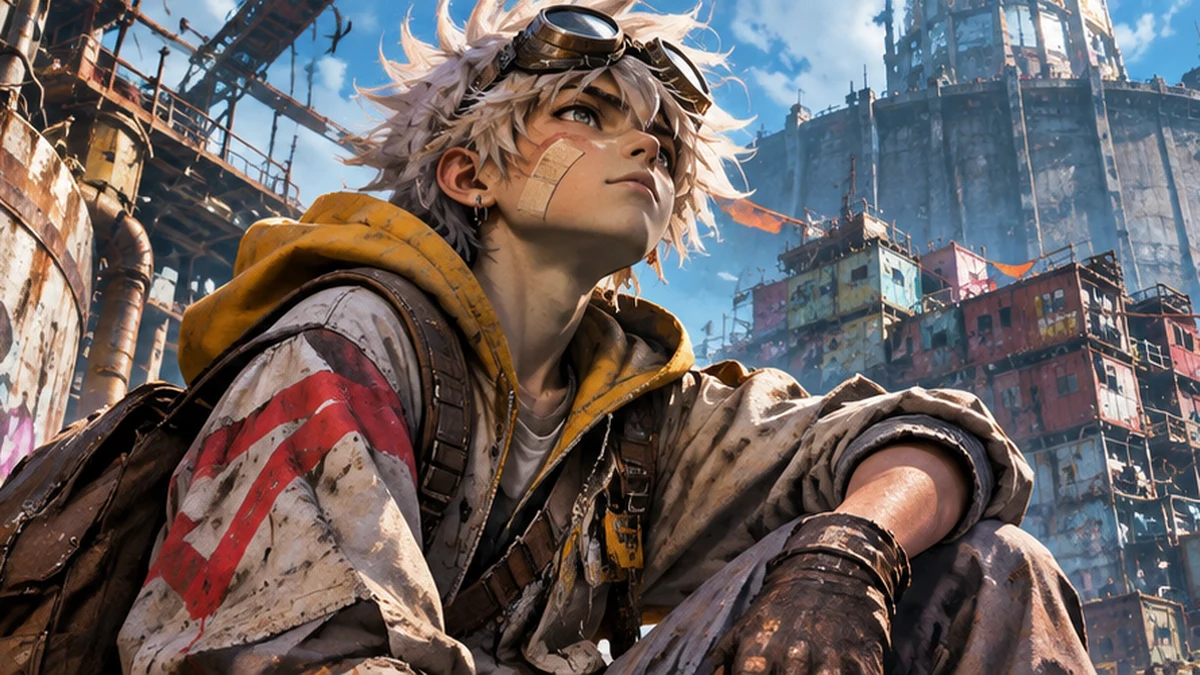
The hiatus was attributed to the need for research connected with the work. There was no announcement of cancellation, health problems, or an editorial dispute. The returning chapter will include color pages.
After roughly three months of waiting, Gachiakuta fans finally have a date to meet Rudo again and follow the next part of his journey!
Kei Urana’s manga is about to resume publication in Japan.
The return is scheduled for November 11, 2026, with chapter 174 in Kodansha’s Weekly Shōnen Magazine.
The news was confirmed by the creator herself, who also announced a special treat: the new chapter will feature color pages.
But why did Gachiakuta go so long without a new chapter?
What happened during the break?
And what should we expect from the return of one of the most visually distinctive series in recent years?
Let’s find out!
Gachiakuta returns on November 11, 2026
Kei Urana confirmed the manga’s return on October 15.
The creator used social media to announce that serialization would resume in November.
That announcement ended a period of uncertainty that began in August, when the series stopped receiving new chapters.
According to the information released, Gachiakuta will return in issue 50 of Weekly Shōnen Magazine for 2026.
Chapter 174 will mark the resumption of serialization.
Urana also said the chapter would include color pages.
That is especially welcome news for fans, given that Gachiakuta’s visual identity is one of the work’s best-known features.
Why did the Gachiakuta manga go on hiatus?
The break began after chapter 173 was published in August 2026.
At the time, the editorial team explained that the creator needed time for research related to the story.
The interruption followed the combined issue 36/37 of Weekly Shōnen Magazine, published on August 5.
Throughout September, readers kept waiting for information on when publication would resume.
Kodansha said a new date would be announced once it had been decided.
Finally, in October, Kei Urana confirmed a November return.
It is important to emphasize that the reason given publicly was the need to research the work.
There is no basis for claiming that the hiatus resulted from health problems or disagreements with the publisher.
Nor was any cancellation announced.
What happened during the three-month break?
Gachiakuta remained a topic of conversation among fans throughout the hiatus.
The series had already earned recognition for its distinctive visual approach, dystopian setting, and characters.
The anime adaptation also helped bring the story to a wider audience.
While no new chapters were appearing, readers revisited earlier events and discussed possible directions for the narrative.
The lack of an official date for part of that period only increased anticipation.
However, October’s announcement clarified that serialization would resume.
Now the biggest question is what will happen in chapter 174 and where the story will go next.
What is Gachiakuta? Meet Rudo and his story
For anyone new to the series, Gachiakuta depicts a world defined by inequality, violence, and the act of discarding things.
Its story follows Rudo, a boy living in an impoverished community in a city suspended high above the ground.
Society in this world is divided by extremely rigid boundaries.
While wealthy residents enjoy comfort, people in marginalized neighborhoods face prejudice and difficult living conditions.
One of the most striking features of this world is the way it handles garbage.
Objects deemed useless are thrown into an enormous abyss.
And people whom society wants to get rid of can suffer a similar fate.
Rudo’s life changes completely when he is falsely accused of murder.
As punishment, he is thrown into the abyss.
But the place that should have meant his end reveals an unexpected world.
There, vast piles of accumulated waste have given rise to monstrous creatures.
To survive, Rudo must learn the rules of this environment and discover how to use special abilities.
It is there that he meets the Cleaners, a group that fights the monsters born from garbage.
From that point on, his journey becomes a search for answers, survival, and justice.
Why is Gachiakuta so different from other shonen manga?
One of Gachiakuta’s greatest strengths is its distinctive visual identity.
Kei Urana’s art uses expressive lines, dense environments, and an urban aesthetic filled with grime, graffiti, and industrial elements.
The graffiti designs are created in collaboration with Hideyoshi Andou.
Together, those elements produce an atmosphere reminiscent of abandoned places, industrial cities, and street culture.
But the visuals are not there merely to impress.
They also strengthen the story’s central themes.
In Gachiakuta, discarded objects matter.
Things treated as worthless can carry stories, emotions, and value.
Likewise, marginalized characters must confront a society that acts as though they do not matter.
That relationship between the art and the narrative is one of the most interesting aspects of the series.
The meaning of objects in Gachiakuta
One of the story’s most important concepts is the value people assign to objects.
In the world of Gachiakuta, some individuals can use powers tied to items with which they share a special bond.
Those objects can become extraordinary tools.
The idea creates a compelling connection between feelings and abilities.
Rather than basing every power solely on physical strength or supernatural energy, the manga emphasizes emotional bonds between people and things.
It also opens the door to a very current issue: throwaway culture.
We live in a society where many products are replaced quickly.
Clothes, electronic devices, and other belongings may be abandoned even while they still work.
Gachiakuta takes an exaggerated, fantastical version of that behavior and uses it to build its world.
The result is an action story that also makes room to reflect on consumption, inequality, and belonging.
Who is Kei Urana, creator of Gachiakuta?
Kei Urana is the Japanese manga creator responsible for both Gachiakuta’s story and artwork.
Serialization began in February 2022 in Kodansha’s Weekly Shōnen Magazine.
Before developing her own series, Urana worked as an assistant to Atsushi Ohkubo, creator of Soul Eater and Fire Force.
That experience helped shape her professional path.
Nevertheless, Gachiakuta has its own artistic identity, particularly in its environments and character designs.
Hideyoshi Andou’s collaboration on the graffiti design also helps make the series’ artwork immediately recognizable.
Does Gachiakuta have an anime adaptation?
Yes!
Gachiakuta’s anime adaptation premiered in July 2025 and was produced by Bones Film.
The anime follows Rudo’s story and his encounter with the world below the suspended city.
The production uses a visual direction intended to preserve essential aspects of the original artwork.
That includes contrasts between urban settings, expressive characters, and creatures formed from waste.
The series is available on Crunchyroll.
A second season has also been announced, although its premiere date has not yet been officially confirmed.
For anyone who discovered the story through the anime, the manga’s return is a chance to follow the latest events in Urana’s world.
What can readers expect from chapter 174?
Chapter 174 will pick up the story after the interruption that began in August.
The return follows events in the story arc known as the Doll Festival.
Because the creator carried out research during the hiatus, fans are curious about how that work might influence what comes next.
However, specific details about the new chapter have not yet been officially disclosed.
Claims about major revelations, character deaths, or permanent changes to the story should therefore be treated as speculation.
What has been confirmed is that the chapter will feature color pages.
That seems like a particularly fitting choice for a series with such a striking artistic identity.
Where can you read Gachiakuta officially?
In Japan, Gachiakuta is published by Kodansha in Weekly Shōnen Magazine.
The publisher also offers digital content through official platforms, including K MANGA, subject to regional availability.
Readers in Brazil should check authorized publication and distribution options.
It is also worth remembering that Japan’s serialization schedule does not necessarily match the release dates of collected volumes in other countries.
That means chapter 174 may reach readers following the original serialization before international volume editions arrive.
Could Gachiakuta win even more fans?
The series has qualities that appeal to different audiences.
On one side are battles, special abilities, and characters struggling against extreme challenges.
On the other is a narrative exploring inequality, prejudice, and the value society places on people and objects.
Its graffiti-influenced, industrial aesthetic also sets it apart from many other series.
With the manga’s return and the continuing anime adaptation, Gachiakuta has opportunities to reach new readers.
However, that growth will depend on the reception of upcoming chapters, distribution, and promotion.
Our expectations: Rudo is ready to return!
Here at Mãe e Filha Geekando, we particularly enjoy stories with unusual worlds and characters who must fight against injustice.
Gachiakuta brings exactly that combination.
Rudo does not simply fight monsters.
He also faces the consequences of living in a society that judges people’s worth by their social position.
Turning discarded objects into sources of power is another fascinating idea.
It reminds us that something seemingly worthless can hold an important story.
That is why we are curious about the manga’s return.
We hope Kei Urana keeps exploring this world with the visual and narrative creativity that made the series stand out.
What about you? Have you been following Gachiakuta in manga form, or did you discover it through the anime?
Tell us in the comments!
Frequently asked questions
When does Gachiakuta return?
Serialization is expected to resume on November 11, 2026.
What will the next chapter be?
Chapter 174.
Why did Gachiakuta go on hiatus?
The reason given publicly was research needed for the work.
Was the manga cancelled?
No. The resumption of serialization was officially announced.
Who created Gachiakuta?
Kei Urana, with Hideyoshi Andou collaborating on the graffiti design.
Does Gachiakuta have an anime?
Yes. The adaptation premiered in 2025 and is available on Crunchyroll.
Will Gachiakuta have a second season?
A second season was announced, but there is still no official premiere date.
💬 What about you?
Do you already follow Gachiakuta through the manga, or did you discover it through the anime?
Tell us in the comments!
Two generations, one geek universe. Mãe e Filha Geekando. 💜📚
📌 Sources consulted
The November 11 return, the stated reason for the hiatus, and the color pages were reported by specialist outlets, including reference sites used by this publication.
Share your thoughts
Comments are sent to our team for moderation and do not appear automatically on the website.