Five horror games that shaped video game history
From fixed-camera mansions to space stations where every sound could signal danger: horror games have changed enormously, but certain titles helped define the genre.
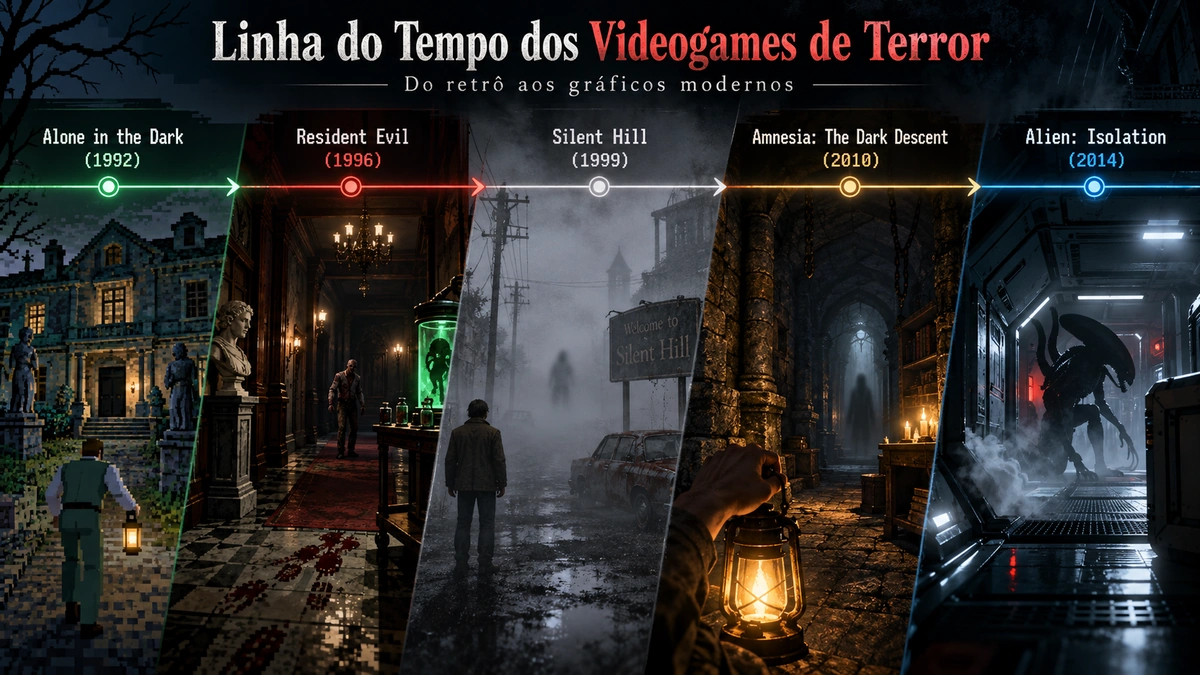
Horror in video games has undergone remarkable transformations.
From dark corridors with simple graphics to realistic environments with three-dimensional audio, developers have found many different ways to inspire fear.
Yet some games stood out for more than their jump scares: they helped define how the genre works.
1. Alone in the Dark (1992)
Long before modern cinematic graphics, Alone in the Dark was already placing players inside a mansion full of mysteries.
Its combination of three-dimensional characters, fixed cameras, exploration and puzzles helped establish conventions that would become important to survival horror.
Players had to investigate their surroundings, manage resources and figure out how to stay alive.
2. Resident Evil (1996)
Originally released for the PlayStation, Resident Evil turned a mansion full of dangerous creatures into one of gaming's most recognizable settings.
Scarce ammunition, inventory management and the need to carefully explore every room helped create a tense experience.
The game cemented the popularity of survival horror and launched one of the genre's most important franchises.
3. Silent Hill (1999)
While many games emphasized creatures and combat, Silent Hill explored psychological fear in depth.
The fog-covered town, unsettling noises and distorted environments created a constant sense of insecurity.
Its protagonist, Harry Mason, was not presented as an extraordinary fighter, which emphasized his vulnerability.
The game demonstrated that atmosphere and suggestion can be just as frightening as direct encounters with monsters.
4. Amnesia: The Dark Descent (2010)
Amnesia helped popularize an approach in which running away and hiding are often more important than confronting enemies.
Players explore a mysterious castle while trying to reconstruct events from the past.
Limited lighting, unsettling sounds and the inability to fight many threats directly create an experience defined by vulnerability.
The game also became well known through videos and livestreams made by content creators.
5. Alien: Isolation (2014)
Inspired by the cinematic universe of Alien, the game follows Amanda Ripley aboard a space station threatened by an extremely dangerous creature.
Its defining feature is the feeling of being hunted.
Players must watch their surroundings, avoid unnecessary noise and use equipment to survive.
The alien's artificial intelligence contributes to unpredictable encounters, sustaining the tension throughout exploration.
🧠 How has fear evolved in video games?
Early games had to work within significant technical limitations.
Fixed cameras, fog and enclosed environments often helped reduce the amount of detail displayed on screen.
But those same limitations also created frightening atmospheres.
As technology advanced, developers began using dynamic lighting, spatial audio and more complex enemy behavior.
Even so, a strong horror experience still depends on something fundamental: the player's anticipation.
Sometimes the most frightening moment is precisely when nothing appears.
👩👧 Two generations of fear
People who started gaming in the 1990s may remember the tension created by simple graphics and limited controls.
Younger players, meanwhile, may be used to realistic environments and first-person experiences.
But do better graphics necessarily mean scarier games?
That's the perfect discussion for Mãe e Filha Geekando.
👻 What about you?
Which horror game frightened you the most: a classic or a modern release?
Tell us in the comments.
Mãe e Filha Geekando — two generations, one geek universe. 💜🎮
Share your thoughts
Comments are sent to our team for moderation and do not appear automatically on the website.