Carrie: from Stephen King's novel to the new series — what changed in 2026?
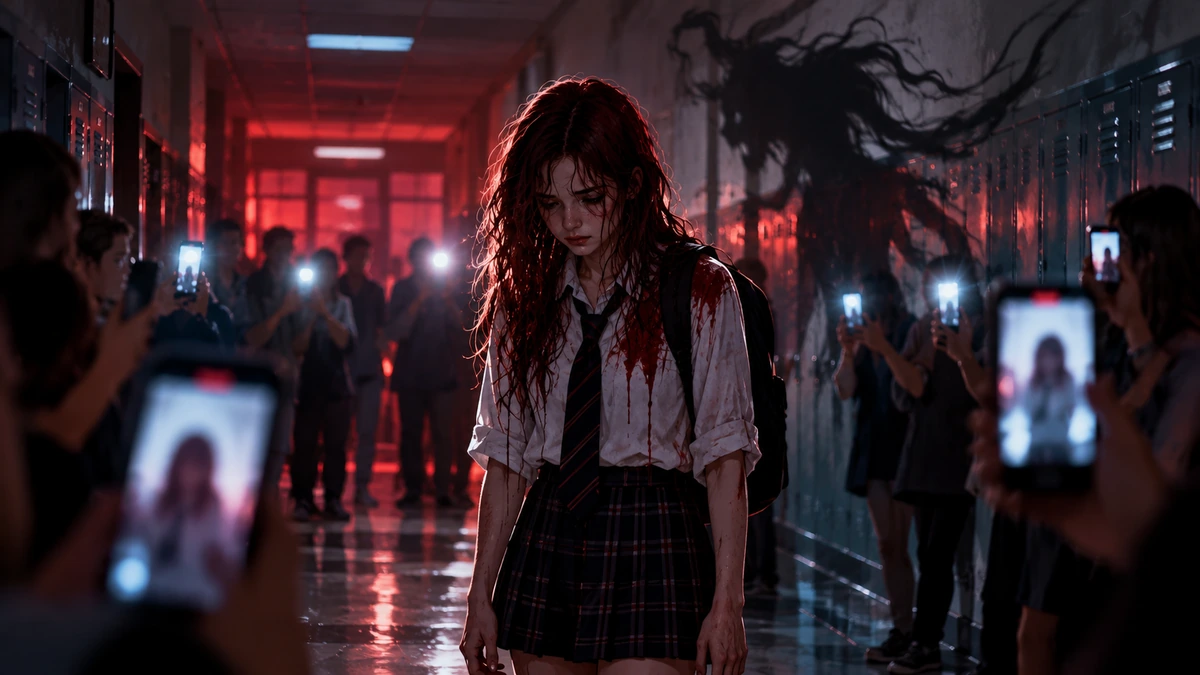
More than fifty years after the original novel, Carrie returns in an adaptation that brings her story into the age of social media, viral content, and permanent exposure.
April 5, 1974
October 7, 2026
8 episodes
Few stories show as clearly as Carrie that horror can begin in completely human situations.
Before the telekinesis. Before the blood. Before the prom.
There is a teenage girl being humiliated.
Published on April 5, 1974, Carrie was Stephen King's first published novel. It follows Carrie White, an isolated young woman raised by a deeply religious mother and constantly bullied at school, who begins discovering her telekinetic abilities.
More than fifty years later, the story received a new adaptation.
The series Carrie, available on Prime Video since October 7, 2026, has eight episodes. The new version updates the story for an era of social media, viral events, and public exposure.
⚡ Horror starts before the powers
It's easy to sum up the story by saying, “A teenager has telekinesis.” But that misses the point.
Carrie doesn't become frightening because she gains powers. The horror was already there.
It appears in the way her classmates treat her.
It appears in how her mother interprets the world.
It appears in the absence of anywhere Carrie can feel safe.
The powers merely change the scale of the consequences.
📖 The 1974 novel
Stephen King builds the novel using different perspectives and documents.
We don't follow Carrie alone. The narrative also includes testimonies and records that help show how events came to be interpreted afterward.
That structure creates an unusual sensation: we know something terrible happened. The question is how everything reached that point.
📱 The series updates the bullying
The new version places Carrie in a contemporary setting.
According to Prime Video's official description, she must deal with an incident of bullying that goes viral and affects the entire community.
That's a significant change.
In 1974, humiliation might have happened within a school. In 2026, it can be filmed, shared, commented on, rewatched, and turned into content by people who don't even know the victim.
That widens the reach of a theme that has always been at the heart of Carrie.
📲 Has cruelty changed, or has it merely gained technology?
That may be one of the new adaptation's most interesting questions.
The tools are different. Human behavior, not so much.
Stephen King wrote about exclusion, shame, fanaticism, and the need to belong. All those elements are still relevant.
The internet simply offers new ways to amplify them.
🕯️ Margaret White
Every version of Carrie depends heavily on her relationship with her mother.
Margaret views the world through oppressive religiosity and tries to control her daughter through fear.
Carrie therefore faces two hostile environments: school and her own home.
It's precisely this lack of safety that makes her story so painful.
📺 What can a series explore better than a movie?
Time.
A feature film has to compress a great deal into roughly two hours.
Eight episodes allow more exploration of school life, classmates, the community, Carrie, her mother, and the consequences of going viral.
Supporting characters can also get more room to develop.
📚 Book versus series: must you choose?
No.
A good adaptation doesn't need to reproduce every page. It needs to understand why a story works.
For Carrie, the essential elements include isolation, bullying, repression, fear, the need to belong, and powers that turn emotions into physical consequences.
If those remain, updating the setting can make sense.
🩸 Why is Carrie still relevant?
Because beneath the supernatural there is an extremely simple question:
This fear doesn't belong only to the 1970s. It belongs to every era.
Perhaps that's why Carrie has traveled through novels, film, television, and theater. Each generation finds a new way to look at her.
👩👧 Mother and daughter reading and watching Carrie
This adaptation also suits our project perfectly.
We can look at school bullying in two different eras, the impact of social networks, and the relationship between mother and daughter — although, fortunately, Margaret White isn't exactly a role model we're planning to follow.
And we can compare a work published in 1974 with a series produced more than fifty years later.
Technology changes. Schools change. Young people change. But certain kinds of pain remain recognizable.
💬 What about you?
Would you rather discover Carrie through the novel or its adaptations?
Tell us in the comments.
Two generations, one geek universe. Mãe e Filha Geekando. 💜🎮
🔗 Related articles
- Dracula: Bram Stoker's classic — COMING SOON
- Five gothic books that helped create modern horror
- American Horror Story: our thoughts on its seasons
📌 Sources consulted
- Stephen King — official Carrie novel page
- Stephen King — official page for the 2026 series
- Prime Video — Carrie
Share your thoughts
Comments are sent to our team for moderation and do not appear automatically on the website.