Manga, manhwa and webtoons: what are the differences and where should you start?
If you like anime, you've probably heard of manga. But what about manhwa? And webtoons?
With the rise of digital comics, these terms have become increasingly popular among fans of Asian culture.
Although all three are connected to the world of comics, they don't mean exactly the same thing.
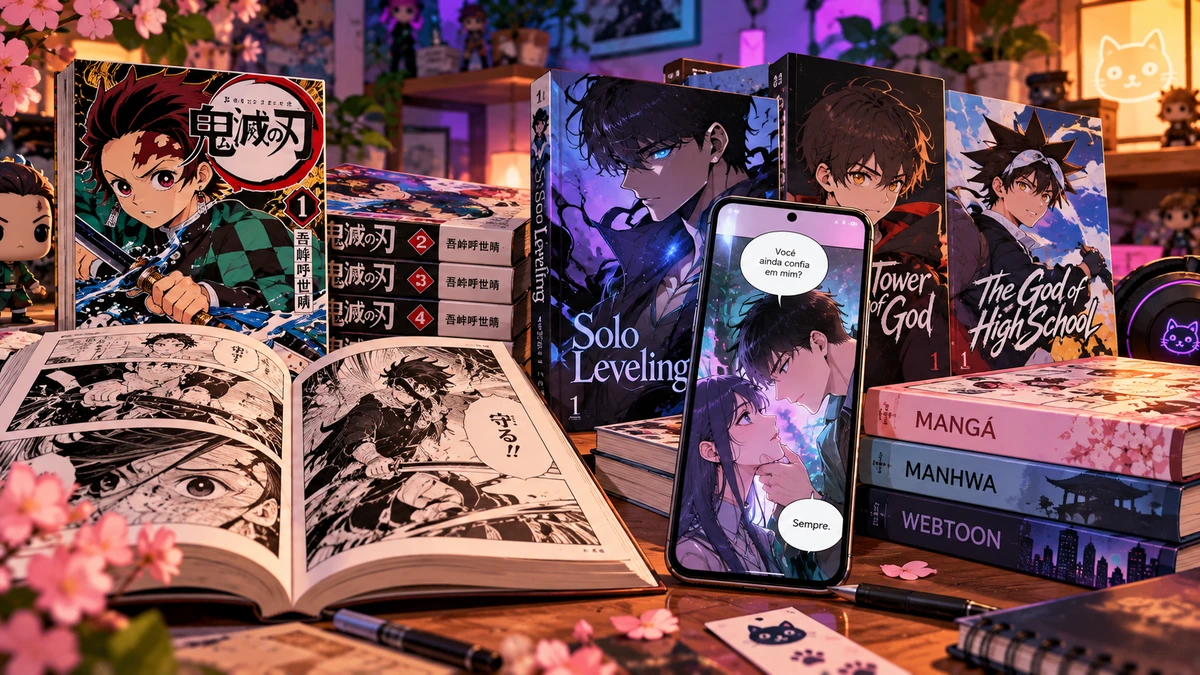
Understanding the differences can help you discover some amazing stories.
Here at Mãe e Filha Geekando, we'll explain each format in simple terms and suggest a few works for anyone looking to explore this universe.
What is manga?
Manga is the term used for comics in Japan. Outside Japan, the word usually refers specifically to comics of Japanese origin.
One of manga's best-known features is the traditional right-to-left reading order, which is preserved in many Brazilian editions.
Another common feature is the use of black-and-white pages, although there are exceptions.
Manga spans many genres and audiences, including adventure, romance, fantasy, suspense, sports and slice-of-life stories.
Famous examples
Naruto: follows a young ninja who wants to earn the recognition of his community.
One Piece: tells the adventures of Monkey D. Luffy and his crew as they search for a legendary treasure.
Death Note: explores an intellectual battle surrounding a supernatural notebook capable of causing people's deaths.
These works show how manga can offer remarkably different narrative styles.
What is manhwa?
Manhwa is the term used for Korean comics.
As with manga, manhwa includes many genres, art styles and intended audiences.
Many contemporary manhwa series gained international recognition through their digital versions and use of color.
However, it's important to remember that not every manhwa is digital or in color.
There are print publications, historical works and different editorial traditions within the Korean comics market.
Titles worth discovering
Solo Leveling: follows Sung Jinwoo, a hunter initially considered very weak who begins developing extraordinary abilities.
Tower of God: follows Bam's journey inside a mysterious tower, where challenges and relationships between characters drive the narrative.
The God of High School: combines martial arts, tournaments and supernatural elements.
These stories helped expand international interest in Korean productions.
So what exactly is a webtoon?
Here is an important distinction.
While manga and manhwa are terms associated with the origin and traditions of comics, webtoon refers to a digital publishing format.
The format is especially known for arranging stories in a vertical sequence designed for reading on smartphones.
Rather than turning pages, readers scroll down the screen to follow the story.
This approach opens up interesting visual possibilities.
The space between panels can be used to build suspense, emphasize movement and control the pace of revelations.
Many webtoons also use color and compositions adapted to mobile screens.
Although the format developed especially in South Korea, there are now webtoon creators in many countries.
Is every webtoon a manhwa?
Not necessarily.
A webtoon created in South Korea can be classified as manhwa because of its origin.
However, a story produced by a Brazilian artist, or an artist from another country, can also use the webtoon format.
Likewise, not every manhwa has to follow the vertical-scrolling format.
That is why the terms are not interchangeable.
What are the main differences?
Manga
- Traditionally associated with Japan.
- Many editions are read from right to left.
- Black and white is very common.
- Can be published in magazines, printed volumes or digital platforms.
Manhwa
- Associated with the Korean comics tradition.
- Can use different reading and publishing styles.
- Includes printed and digital works.
- Covers many genres and audiences.
Webtoon
- A format designed primarily for digital reading.
- Usually uses vertical scrolling.
- Typically offers an experience optimized for phones.
- Can be created by artists from different countries.
How do you choose your first read?
If you enjoy Japanese anime, starting with the manga that inspired a familiar series can be an excellent choice.
That way, you can compare the animated adaptation with the original work.
Anyone who prefers action, fantasy and character progression might try titles such as Solo Leveling.
Readers who appreciate the convenience of their phones can start with a webtoon and enjoy the vertical reading experience.
The important thing to remember is that none of these formats is inherently better than the others.
Each has its own characteristics, storytelling possibilities and art styles that may appeal to different readers.
Two generations, different ways of reading
For a long time, collecting physical volumes was one of the main ways to follow comic-book stories.
Today, readers can also discover new works through apps and digital platforms.
This creates an interesting opportunity to compare experiences.
One person might prefer arranging books on a shelf, while another values the convenience of carrying several stories on a phone.
And there's nothing wrong with enjoying both options!
Now we'd love to know: do you prefer physical manga, manhwa or digital webtoons? Which story would you recommend to someone just starting out?
Two generations, one geek universe. Mãe e Filha Geekando.
Share your thoughts
Comments are sent to our team for moderation and do not appear automatically on the website.